AI for Strategy vs. AI Strategy: Which One You Need
The two phrases sound alike and mean different things, and mixing them up wastes time. AI for strategy means using AI as a working tool to do strategic analysis and planning — competitive analysis, market scans, SWOT, scenario planning, goal setting. AI strategy means deciding how an organization will adopt AI itself: which use cases, what data, which governance and which budget.
This library is mainly about the first: AI as a strategy tool, run inside proven frameworks. It also covers the second, because the same discipline applies — a structure, a set of questions and a human who decides. Guides about planning an AI adoption sit in their own domain, "AI Strategy & Adoption", and point to the standard references such as the NIST AI Risk Management Framework and the Microsoft Cloud Adoption Framework for AI.
Why Strategy Frameworks with AI Work Better
AI on its own is a fluent guesser. Ask it for "a strategy" and it returns something that sounds plausible and fits nobody. A strategy framework fixes that by giving the AI a structure and giving you a way to check its work. When AI runs a SWOT analysis or a Five Forces review inside a framework, every claim lands in a labeled box you can challenge, correct and improve.
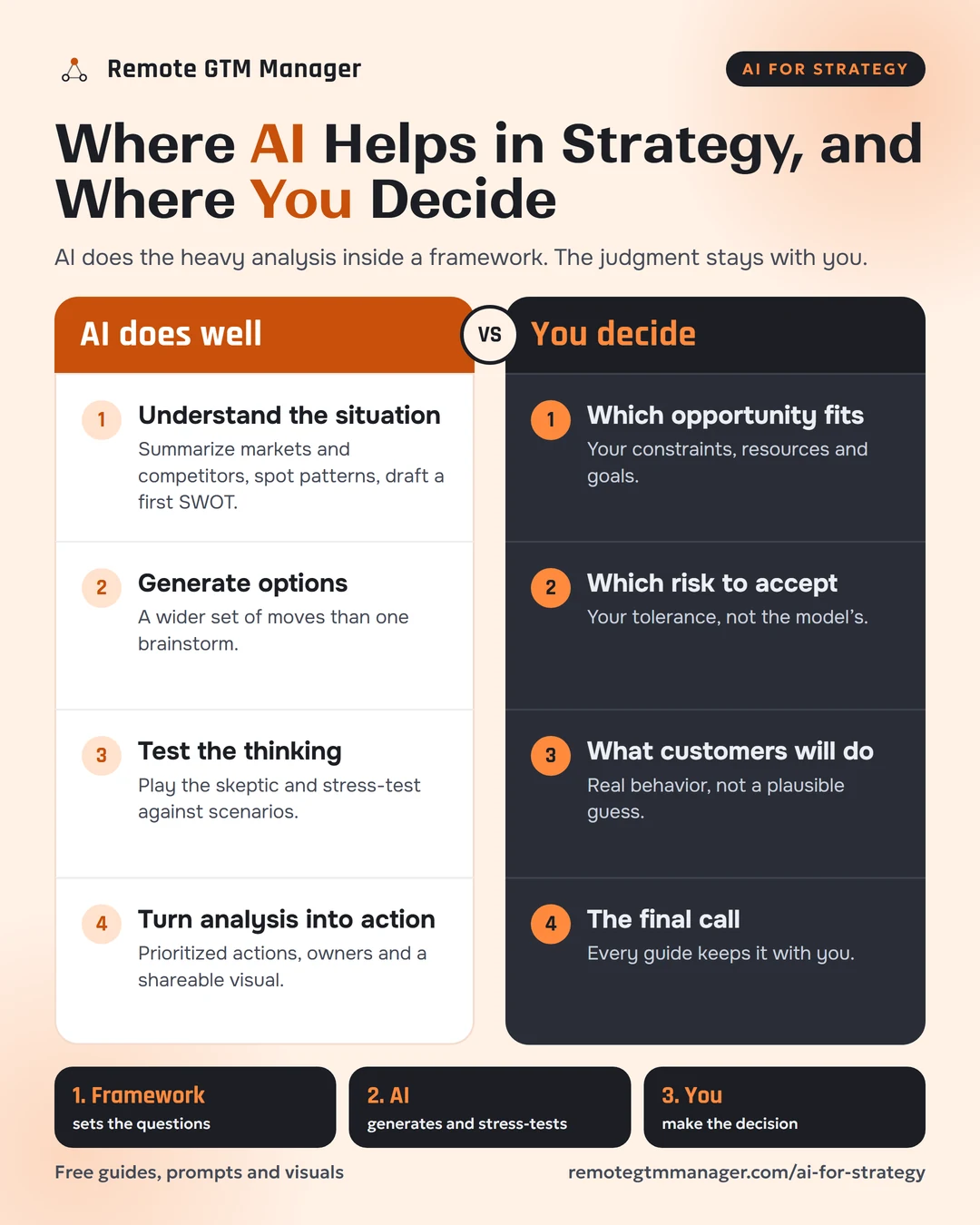
That is why strategy frameworks with AI beat both extremes. Doing the framework by hand is slow and tends to stop at the first obvious answers. Asking AI without a framework is fast but unfocused. Combining them gives structured thinking at AI speed, with a human making the actual decisions. Every guide keeps that division of labor explicit: the framework sets the questions, the AI generates and stress-tests, and you decide.
Which Strategy Framework to Use When
- Where do we stand today? SWOT analysis for the overall picture, VRIO for which resources are a real advantage.
- What is changing around us? PESTEL analysis for external forces, scenario planning for several possible futures.
- How hard is this market? Porter's Five Forces for competitive pressure and profit potential, moat analysis for whether an advantage will last.
- What kind of problem is this? Cynefin to tell clear from complex, TRIZ and Duncker diagrams when the problem is stuck on a contradiction.
- Where is the bottleneck? Theory of Constraints for the limit on output, Kaizen for steady improvement after it.
- Where could we grow? Ansoff Matrix for growth options, Blue Ocean strategy for uncontested space.
- How does the business actually work? Business Model Canvas for the model, value chain analysis for where value is created.
- Who are we serving, and why do they buy? Jobs to Be Done for the customer's real need.
- How do we set and track goals? OKRs for focus, the Balanced Scorecard for a rounded view of performance.
Where AI Goes Wrong in Strategy Work
- It states guesses as facts. Always ask the AI to label what is an assumption and what is evidence, then verify the evidence yourself.
- It reflects its training data. Historical patterns and popular opinion bias the output toward what is common, not what fits your market.
- It lacks your context. Strategy depends on things the AI cannot see: your constraints, your relationships and your appetite for risk.
- It leaks what you give it. Never paste confidential, regulated or client data into a public AI tool; anonymize first.
- It makes over-reliance easy. Decisions, priorities and trade-offs stay human. The library is built around that rule, an approach the Balanced Scorecard Institute calls augmented strategy.
How the Library Is Organized
Guides are organized two ways, so the library stays useful as it grows. Domains group guides by the business area they serve: business strategy, business process, operations, marketing and growth, product and innovation, market and competitive analysis, decision-making and risk, and AI strategy and adoption. Framework clusters group every guide about one framework in one place, so all the SWOT analysis guides sit together, all the Five Forces guides sit together, and so on.
A guide belongs to one domain and, where it applies, one framework cluster. A guide on running a SWOT analysis for a new product, for example, sits in the product and innovation domain and in the SWOT analysis cluster. Start from the domain when you have a problem, and from the framework when you already know the tool you want.
Frameworks Covered
The library goes well past the textbook basics. It starts with the advanced tools that strategists use when a standard SWOT is not enough, and it covers the classics too, because teams still need them done properly.
- TRIZ analysis with AI. Systematic inventive problem solving: turn a contradiction (improving one thing makes another worse) into tested solution ideas.
- Duncker diagram with AI. Branch a stuck problem from general solutions down to functional and specific ones, so no path goes unexplored.
- Wardley Mapping with AI. Map your components by visibility and evolution to see where to build, buy, or wait.
- Cynefin framework with AI. Decide whether a problem is clear, complicated, complex or chaotic before choosing how to act on it.
- Moat analysis and 7 Powers with AI. Test whether an advantage lasts, and which source it comes from: scale, network effects, switching costs, brand, cornered resources or process power.
- Scenario planning and Three Horizons with AI. Build and stress-test several futures, and balance today's core business against emerging and future bets.
- Playing to Win and OODA loop with AI. Choose where to play and how to win, then speed up the decision cycle that keeps the choice current.
- Theory of Constraints, Kaizen and Lean Six Sigma with AI. Find the one bottleneck that limits output, then improve the process in small, steady, measured steps.
- Systems thinking, first principles and pre-mortems with AI. Map feedback loops, rebuild an assumption from its basics, and find the ways a plan will fail before it does.
- Root cause analysis, Kano model and opportunity solution trees with AI. Trace a problem to its source with 5 Whys and fishbone diagrams, and tie customer needs to the product bets worth making.
- The classics, done properly. SWOT, PESTEL, Porter's Five Forces, Business Model Canvas, OKRs, Ansoff and BCG matrices, value chain, VRIO, McKinsey 7-S, Jobs to Be Done and Blue Ocean strategy, each pressure-tested with AI instead of brainstormed.
More frameworks are added as the library grows, and each one gets its own dedicated page.
Visual Guides
Strategy gets understood faster when you can see it. Every major guide ends with a visual: a framework diagram, a filled-in example or a one-page summary that makes the whole method clear at a glance. Save them, share them with a team, or keep them beside your screen while you run the prompts.
About the Author
I'm Md. Istiqur Rahman, a Remote GTM Manager with 18+ years in organic SEO, marketing and hands-on strategy for solopreneurs and entrepreneurs. The guides here are the frameworks I actually use with clients, rewritten so you can run them yourself — with AI where it helps and without it where it does not. Read more about me.
Frequently Asked Questions
What is AI for strategy?
Using AI to carry out strategic analysis and planning — most reliably by running established strategy frameworks, from classics like SWOT to advanced tools like TRIZ and Wardley Mapping — so the AI works inside a structure you can check.
How can AI be used in strategic planning?
AI can gather and organize market and competitor information, draft framework analyses, generate and compare options, simulate scenarios and challenge assumptions. People still set the goals and make the decisions.
Can ChatGPT do a SWOT analysis?
Yes, as a first draft. Give it concrete context, ask it to label assumptions versus evidence, and then verify the evidence and challenge the result. The TRIZ prompt above shows the same pattern.
What are strategy frameworks with AI?
Established strategy frameworks run with AI help: the framework supplies the structure and the questions, while the AI generates, expands and stress-tests the answers.
What is the difference between AI strategy and AI for strategy?
AI strategy is the plan for adopting AI inside an organization. AI for strategy is using AI to do strategic work, such as competitive analysis or scenario planning. This library focuses on the second and also covers the first.
Can AI replace strategic thinking?
No. AI speeds up the analysis, widens the options and challenges assumptions, but decisions, priorities and trade-offs stay human.
Is it safe to put business data into AI tools?
Not without care. Do not paste confidential, regulated or client data into a public tool. Anonymize details, use placeholders and follow your tool's data policy.
Do I need a paid AI tool?
No. The prompts are written for the AI assistant you already use. You paste them in and adapt a few details to your business.
Which businesses are these guides for?
Solopreneurs, entrepreneurs and startups who want proper strategic analysis without hiring a consultancy to run the basics.
How often are guides published?
There is no fixed schedule. Guides go live when they are genuinely useful, and the free Strategy Framework Newsletter for Businesses sends each framework guide, prompt pack and visual straight to your inbox.
What is TRIZ analysis with AI?
TRIZ is a method for inventive problem solving, built by Genrich Altshuller from studying patents. It treats a problem as a contradiction, where improving one thing makes another worse, and applies proven inventive principles to resolve it. With AI, you describe the contradiction, the AI suggests which principles fit and drafts solution ideas, and you test which ones are feasible.
What is a Duncker diagram and how does AI help?
A Duncker diagram, named after the psychologist Karl Duncker, maps a stuck problem as a tree that runs from general solutions to functional solutions to specific ones. AI generates branches at each level so no path is skipped, and you prune the ones that do not fit your constraints.
What is Wardley Mapping with AI?
Wardley Mapping, created by Simon Wardley, places the parts of a business on a map by how visible they are to the customer and how far each has evolved, from new and custom to commodity. AI drafts the value chain and suggests where each part sits, then asks why. You confirm the placements, because they depend on market knowledge only you hold.
What is the Cynefin framework and how do I use it with AI?
Cynefin, created by Dave Snowden, sorts a situation into clear, complicated, complex or chaotic, because each needs a different response: apply best practice, analyze, experiment, or act first. AI classifies your situation with its reasons and suggests the matching approach. You review the reasoning, because a wrong classification leads to the wrong response.
What is moat analysis, and what are the 7 Powers?
Moat analysis tests whether a competitive advantage will last. Hamilton Helmer's 7 Powers names seven sources of durable advantage: scale economies, network effects, counter-positioning, switching costs, branding, cornered resources and process power. AI acts as a skeptic, challenging each claimed moat and flagging the ones a competitor could copy.
What are scenario planning and Three Horizons?
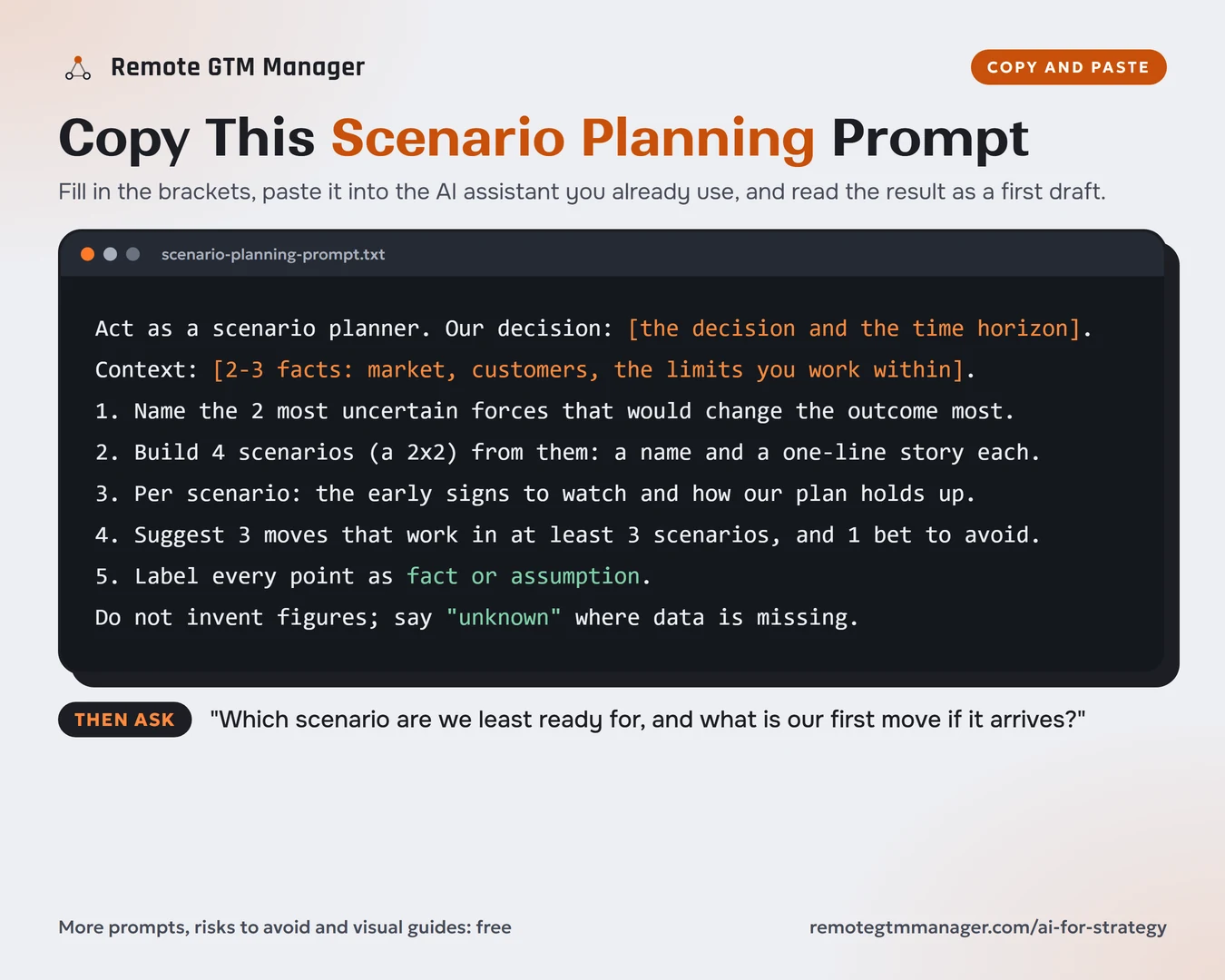
Scenario planning builds several plausible futures and tests a strategy against each, instead of betting on a single forecast. Three Horizons balances today's core business (horizon one) against emerging bets (horizon two) and future options (horizon three). AI drafts distinct scenarios and sorts initiatives by horizon, and you decide which signals to watch.
What are Playing to Win and the OODA loop?
Playing to Win, from A.G. Lafley and Roger Martin, is a cascade of five choices: your winning aspiration, where to play, how to win, the capabilities needed and the management systems to support them. The OODA loop, from John Boyd, is a cycle of observe, orient, decide and act. AI drafts options for each choice and speeds up the observe and orient steps, while the decisions stay with you.
How do Theory of Constraints, Kaizen and Lean Six Sigma work with AI?
Theory of Constraints finds the single bottleneck that limits output. Kaizen improves a process through small, steady changes. Lean Six Sigma removes waste and variation, using DMAIC (define, measure, analyze, improve, control). AI reads your process notes, suggests the likely constraint or source of waste and drafts the next experiment, but it needs real measurements from you to be useful.
What are systems thinking, first principles and pre-mortems?
Systems thinking maps feedback loops and second-order effects before you act. First principles thinking breaks an assumption down to its basic facts and rebuilds from there. A pre-mortem imagines the plan has already failed and asks why. AI is useful for each: it draws the loops, challenges assumptions and plays the adversary that finds the failure points.
What are root cause analysis, the Kano model and opportunity solution trees?
Root cause analysis traces a problem to its source with tools like 5 Whys and fishbone diagrams. The Kano model sorts features into must-haves, performance features and delighters. An opportunity solution tree links a target outcome to customer opportunities, solutions and the experiments that test them. AI drafts each structure from your notes and customer research, and you check it against real evidence.
Which strategy framework should I start with?
Start with the question you are trying to answer. If you are unsure what kind of problem it is, Cynefin sorts it first. If you want an honest read of your position, use SWOT or a moat analysis. If you are facing an uncertain future, use scenario planning. The "Which Strategy Framework to Use When" section above maps common questions to frameworks.
Do I need to know a framework before using it with AI?
No. Each guide explains the framework from scratch, covering what every part means, when to use it and where it misleads, before it gives you the prompts. Knowing the basics does help you challenge the AI's output, which is why the explanation always comes first.
Can I combine several frameworks in one analysis?
Yes, and it often works better than a single framework. A common sequence is Cynefin to classify the problem, then a framework that fits the answer, such as scenario planning for an uncertain future, and a pre-mortem to stress-test the resulting plan. Run each framework as a separate step with its own prompt, so the AI keeps the structure clean.
Can I suggest a framework or a business scenario?
Yes — email me with what you would like covered.